F136 - tech blog

A simple blog in the complex world of healthcare telematics.
Visit us:
FHIRPath In Production: Why It Matters In DEMIS
by Tabea Harper, Daniel Reckel, reading time:
11 mins
Executive Summary
DEMIS uses FHIRPath to implement scenario-driven validation of FHIR notifications. Close collaboration with project partner RKI and the clever integration of FHIRPath expressions into a Java-based microservice has resulted in a flexibly expandable, easily maintainable construct that enables rapid technical validation.
Note: This is Part II of a three-part series. Part I gives an overview of the use of FHIRPath in DEMIS and Part III dives into routing.
Part II – Lifecycle Management As Scenario-Driven Validation of FHIR Notifications
Motivation And Value
FHIR notifications in DEMIS have a defined lifecycle depending on the type of notification. A notification contains information about the detection of a pathogen or the suspicion of a disease in a patient. The lifecycle management (LCM) defines various valid scenarios for notifications. Each scenario has rules based on the combination of values of specific elements of a notification. Part of the validation of incoming FHIR notifications in DEMIS is to check if it is valid regarding the lifecycle. Due to the complexity of the rules, it is hard to implement them in a maintainable way using traditional programming languages. Using FHIRPath expressions to define the rules has several advantages:
- Compactness: FHIRPath expressions are concise and can express complex logic in a few lines.
- Readability: The declarative nature of FHIRPath makes it easier to understand the rules at a glance.
- Maintainability: Changes to the rules can be made by updating the FHIRPath expressions without modifying the underlying codebase.
DEMIS Lifecycle Management And Scenarios
The functional aspects of the DEMIS interface are handled by our project partner Robert Koch-Institut (RKI). The RKI consolidates the domain expertise on legal and substantive questions, while the gematik-team is responsible for the technical implementation and operations.
In addition to FHIR profiling for creating the data model and the API, the RKI-team also conducted a comprehensive content review of the notifications. These notifications should never be seen in isolation, as several notifications can relate to a single infection. Laboratory notifications confirm the infection and include information about sample testing, such as sample type, specific test used, or detected antibiotic resistance. Meanwhile, disease notifications contain details about the patient’s condition and contextual background, for example the location of infection depending on the type of infectious disease.
The relationship between notifications is crucial and can be established through IDs linking them together. Each initial notification should have a unique ID, to not link it to another notification of a different disease category or patient by mistake. However, these links only make sense if the corresponding values are populated accordingly within each notification. Quality management of the notifications is therefore handled through the LCM. Encoding these rules directly into the profiled resources would make them more rigid and harder to maintain, so it was decided to communicate them via the additional guidance in the Implementation Guides for laboratory notifications and disease notifications.
The scenarios therefore revolve around initial notifications, follow-up notifications, supplementary notifications, and correction notifications. While for example initial notifications must not contain an ID that already belongs to existing notifications, correction, supplementary, or follow-up notifications can only be processed if a corresponding initial notification has already been received.
While an external reader may not see any differences between follow-up, supplementary, and correction notifications, these messages do differ either in their technical structure or in the values they carry. Follow-up notifications, for instance, use a relatesTo relationship via the Composition resource and do not require a named individual. They are typically sent by secondary laboratories that do not have access to personal data of patients. A supplementary notification, on the other hand, is sent by the primary laboratory to contribute additional information. This happens, for example, for a long-running test or a test confirmation. This overlaps with a correction notification, which revises the overall result of a previous analysis, although in theory such a correction could also be issued as a follow-up notification. Drawing clear boundaries is therefore difficult, a challenge already hinted at in the RKI’s initial scenario table.
Robust Rule Design
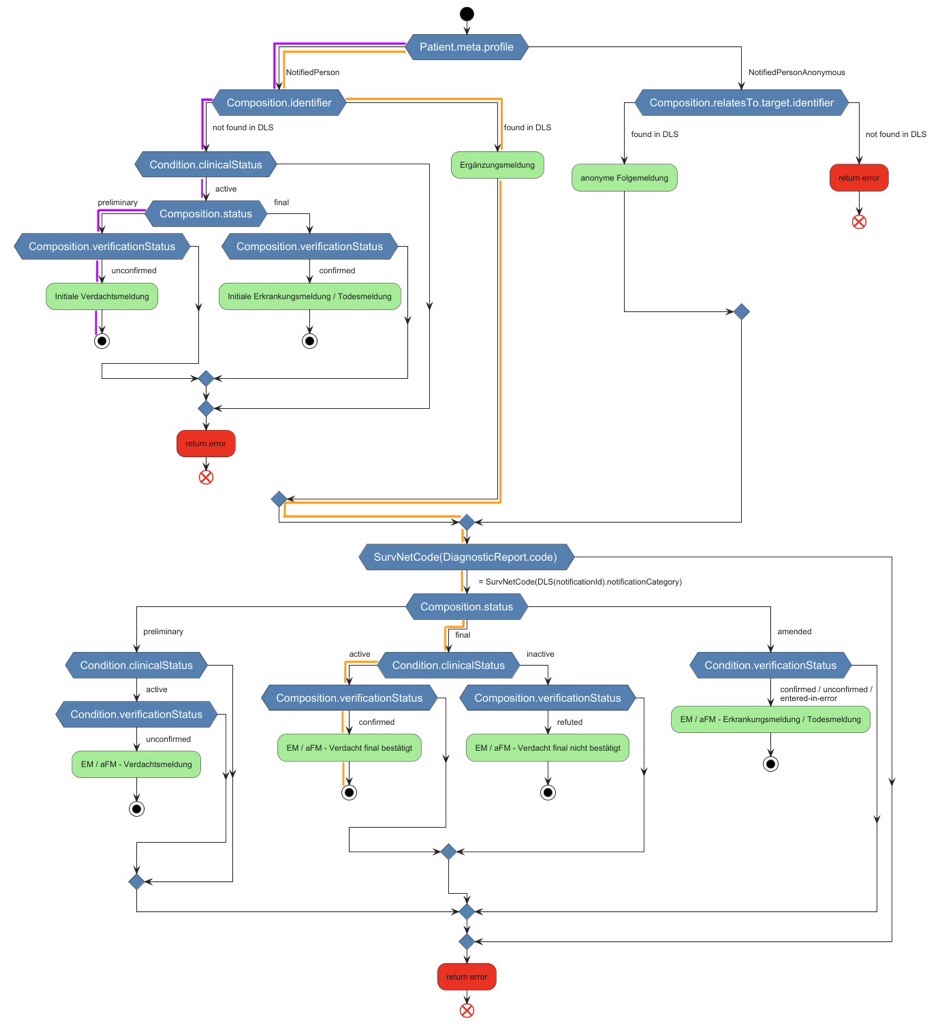
The RKI defines functional, real world scenarios based on their and German health office experiences. These scenarios have to be translated into unique technical scenarios with unambiguous rules. Therefore, the RKI provided a scenario table through their Implementation Guides that lists all relevant scenarios and the allowed values of elements. Some of the defined functional scenarios could be removed due to technical overlap in field values, as the remaining differences are purely functional and irrelevant for the lifecycle validation. To improve traceability, both project partners together created a scenario decision tree that breaks down the scenarios into smaller decision nodes, making it easier to understand the LCM. From a domain driven perspective this approach results in common language between the technical and functional teams in form of the decision tree.
Rule Implementation and Integration
We implemented the actual validation using HAPI FHIR. The framework provides an API for executing FHIRPath expressions but requires an extension of the resolve() method, which must be implemented by the user (see part one of this series).
Static Validation via FHIRPath Expressions
For each scenario in the rule tree, we generate matching FHIRPath expressions and apply them to the message under review. Because the rule tree—unlike the RKI table—does not allow duplicate scenarios, we reduce the number of checks to the minimum necessary. This static validation can be made without any other context. It just validates the state of fields in the current notification. If all static checks are valid, the external checks will be performed.
Dynamic Validation via External Checks
External Checks prove for initial notifications, that no other notification with the same ID exists. Furthermore, the LCM describes scenarios for supplementary and follow-up notifications that require the reference to an initial notification with the same ID and disease category.
These external checks should not be made static due to the limited scope to the state of the current notification. They require the context of all previous notifications in the lifecycle via additional validation logic in Java. The notification or relatesTo ID can be extracted from the current notification via FHIRPath in the external check and is used to make a dynamic request to a service, that serves the notification category of a previous notification, with the same Notification ID. For supplementary or follow-up notifications the received disease category will be compared with the one extracted by FHIRPath from the current notification.
If the external check for the scenario is valid as well, the notification is valid in its lifecycle.
Performance
There are several straightforward measures to improve performance:
- Instead of relying on a single, lengthy FHIRPath expression, we break the requirements into smaller chunks. The advantage is that we can terminate a validation much earlier; in the long run, we could also consider evaluating them in parallel.
- We only query external services—for example, to validate IDs from previous notifications—after all other checks have passed. This reduces the number of calls within the microservice cluster.
- The rule design avoids duplicating rules wherever possible.
- We view rapid maintenance and updates as a performance gain, so we work closely with our project partner on a shared foundation: the decision tree.
In Part III we will discuss our routing implementation which is closer to a decision tree. We will examine which option is more practical and enables better cooperation with our project partner. The development process is not yet complete at this point and will certainly be part of a later blog entry.
DEMIS Example
The following example shows the validation configuration for the scenario of an initial preliminary disease notification, where the disease is not confirmed yet, but suspected. This is described by the purple path in the decision tree above. The expression “Patient.profile(byName)” mirrors the first node in the decision tree and checks whether the patient resource in the bundle has the profile “NotifiedPerson” for identified patients. Each other FHIRPath expression should be also displayed over a node in the tree. The external check for this scenario is of type NOTIFICATION_ID_NOT_EXISTING, meaning it is an initial notification scenario.
{
  "name": "S_IM_V",
  "fhirPathExpression": [
    {
      "fhirPath": "Patient.profile(byName)"
    },
    {
      "fhirPath": "Composition.status(preliminary)"
    },
    {
      "fhirPath": "Condition.clinicalStatus(active)"
    },
    {
      "fhirPath": "Condition.verificationStatus(unconfirmed)"
    }
  ],
  "externalChecks": [
    {
      "type": "NOTIFICATION_ID_NOT_EXISTING",
      "inputs": {
        "id": "NotificationId"
      }
    }
  ]
}
The next example shows the configuration for a supplementary notification, were the suspected disease from the initial notification before is confirmed. This is described by the orange path in the decision tree above. As already mentioned, supplementary notifications must reference an existing initial notification. Therefore, an external check of type CATEGORY_MAPPING is performed to verify that the referencing notification ID exists in the system and is linked to a notification with the same disease category.
{
  "name": "S_FM_V2EoT",
  "fhirPathExpression": [
    {
      "fhirPath": "Patient.profile(byName)"
    },
    {
      "fhirPath": "Composition.status(final)"
    },
    {
      "fhirPath": "Condition.clinicalStatus(active)"
    },
    {
      "fhirPath": "Condition.verificationStatus(confirmed)"
    }
  ],
  "externalChecks": [
    {
      "type": "CATEGORY_MAPPING",
      "inputs": {
        "id": "NotificationId",
        "hasToExist": true,
        "notificationCategory": "NotificationDiseaseCategory"
      }
    }
  ]
}
For better readability and reuse, we have replaced the FHIRPath expressions with short codes. In a second file, we have documented the concrete FHIRPath expressions that these codes resolve to.
{
  "Patient.profile(byName)": "Bundle.entry.resource.where($this is Patient).meta.where(profile = 'https://demis.rki.de/fhir/StructureDefinition/NotifiedPerson').exists()",
  "Composition.status(preliminary)": "Bundle.entry.resource.where($this is Composition).where(status = 'preliminary').exists()",
  "Composition.status(final)": "Bundle.entry.resource.where($this is Composition).where(status = 'final').exists()",
  "Condition.clinicalStatus(active)": "Bundle.entry.resource.where($this is Condition).clinicalStatus.coding.where(code = 'active').exists() or (Bundle.meta.profile = 'https://demis.rki.de/fhir/StructureDefinition/NotificationBundleDisease' and Bundle.entry.resource.where($this is Condition).clinicalStatus.empty())",
  "Condition.verificationStatus(unconfirmed)": "Bundle.entry.resource.where($this is Condition).verificationStatus.coding.where(code = 'unconfirmed').exists()",
  "Condition.verificationStatus(confirmed)": "Bundle.entry.resource.where($this is Condition).verificationStatus.coding.where(code = 'confirmed').exists()",
  "NotificationId": "Bundle.entry.resource.where($this is Composition).identifier.where(system='https://demis.rki.de/fhir/NamingSystem/NotificationId').value",
  "NotificationDiseaseCategory": "Bundle.entry.resource.where($this is Condition).code.coding.where(system='https://demis.rki.de/fhir/CodeSystem/notificationDiseaseCategory').code"
}
What’s Next
In Part III, we will cover smart routing and orchestration with practical integration notes.
About The Authors
Tabea is a Junior Software Developer and has only recently joined the team. Using FHIRPath was one of her first tasks, and she has been an enthusiastic user ever since.
Daniel is a Senior Software Developer and works on the DEMIS backend since 2021 with great expertise in Java and FHIRPath.
Tabea and Daniel worked together to revise the implementation of lifecycle management in DEMIS. Their goal was to create an easy-to-understand and clear configuration that could also be understood and maintained by non-developers from project partner RKI. The previous version, which was based purely on Java code, had proven itself, but had become very communication-intensive to maintain.